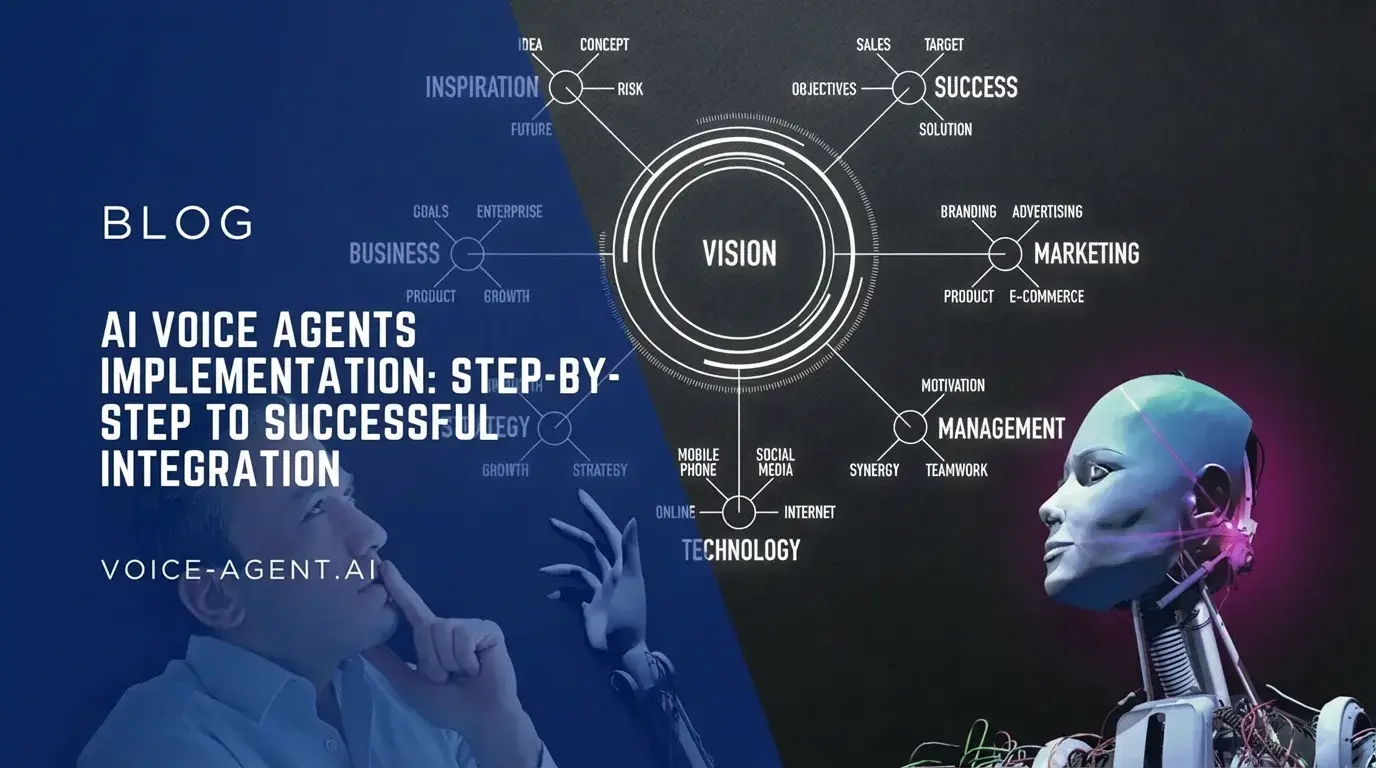
# AI Voice Agent Implementation: Step-by-Step Guide to Successful Integration
Table of Contents:
The Transformation of Customer Interaction Through Voice Assistants
Imagine being able to provide your customers with a personal assistant who is available around the clock, understands them perfectly, and intelligently handles even complex inquiries! With the right AI voice agent implementation, exactly that is possible today. Voice-controlled interaction has experienced an enormous upswing in recent years -- in 2023, 60% of users were already regularly using voice assistants in some form.
In this guide, we focus on practical implementation and show you step by step how to develop successful AI voice agents and integrate them into your existing systems.
The Basics of AI Voice Agents -- The implementation of an AI voice agent begins with a clear understanding of the fundamentals. Unlike the wholesale adoption of existing solutions, a successful voice agent requires a customized approach.
The Basics of AI Voice Agents
First, you need to define the specific area of deployment for your voice agent. Do you want to primarily use it for customer service, should it support you in sales, or perhaps even take over cold calling? Each use case brings its own requirements.
Users expect precise and correct language -- grammatical errors or unnatural formulations quickly lead to a loss of trust. The question of how to address users is also crucial: do you use informal or formal language? This decision depends heavily on your target audience and industry.
Another important aspect is selecting the right AI language models. Make sure that the chosen model can understand nuances, dialects, and colloquial expressions.
Preparations for Successful Implementation
Thorough preparation is the key to success when implementing your AI voice agent. Before diving into the technical implementation, you should complete some important preliminary work.
Choosing the technological foundation is one of the first decisions. Various NLP frameworks and speech recognition technologies come into consideration. When selecting, you should look for good language support, flexibility, and scalability.
Your resource planning should be realistic. Developing a high-quality voice agent typically requires:
An interdisciplinary team (developers, linguists, domain experts)
An appropriate budget for tools, licenses, and personnel costs
A realistic timeframe (typically 3-6 weeks for an initial version)
Special expertise for speech analysis and conversation design
Particularly important is building a high-quality training dataset. This should contain typical user inputs in various formulations, with regional differences and colloquial variants. The more diverse and representative this dataset is, the better your voice agent will function later.
Training Data Category
Important Aspects
"Good morning," "Hello," "Hi there"
Consider regional differences
Standard Inquiries
"I would like to schedule an appointment"
Include various levels of formality
Industry-Specific Terminology
Consider professional jargon
"That wasn't helpful," "I'd like to speak to a human"
Recognition of dissatisfaction
In parallel, you should develop an intent library. Intents are the purposes or goals behind user inputs. A well-structured intent library helps your voice agent correctly understand user concerns and respond accordingly.
A detailed project timeline with clear milestones helps you keep track and monitor progress. Define responsibilities from the start and establish regular check-ins to identify and address problems early.
Technical Implementation of Your AI Voice Agent
### Selecting the Right AI Platform
Choosing the right AI platform is crucial for the success of your voice agent. Not all platforms offer the same quality for speech processing.
When evaluating speech processing quality, you should pay particular attention to accuracy with different text inputs, recognition of regional dialects, and handling of colloquial language. Ideally, you should run tests with real examples before making a final decision.
Integration options with your existing systems also play an important role. Check whether your chosen platform offers API interfaces for your CRM systems, databases, and other tools. The more seamless the integration, the more valuable your voice agent will be.
Don't underestimate the importance of scalability and cost structure. Some platforms charge fees per request, others per user or based on usage duration. Choose a model that fits your growth goals and doesn't become disproportionately expensive with increasing user numbers.
### Developing the Conversation Flow
The conversation flow is the heart of your voice agent. It defines how the conversation between user and agent proceeds and how different inputs are handled.
Start by creating a logical conversation flow that maps natural dialog paths. Unlike rigid decision trees, modern voice agents should be able to flexibly respond to different formulations and conversation trajectories.
Fallback mechanisms for misunderstood inputs are also essential. Develop polite and helpful follow-up questions when the agent doesn't understand an input. These follow-up questions should sound neither too colloquial nor too formal.
Integrating small talk and personal elements can make your voice agent more likeable. Pay attention to cultural appropriateness -- an appropriate friendly tone is important.
Branching logic for different user intentions helps your agent flexibly respond to topic jumps or unexpected questions. A good voice agent should also be able to steer the conversation back to the original topic when appropriate.
### Speech Training and Intent Recognition
Speech training and intent recognition are technically demanding but crucial steps in implementation. They largely determine how well your voice agent understands user inputs and responds to them.
Building and training the NLU model (Natural Language Understanding) requires linguistic expertise. Ideally, you first collect hundreds or even thousands of authentic example sentences of how users might express their concerns. You then assign these sentences to the corresponding intents.
When implementing various intents and entities, you should consider linguistic peculiarities. Complex compound words, variable word order, and complex grammatical structures present special challenges.
Creating context parameters for multi-step conversations allows your agent to remember previous statements and respond contextually. This is particularly important for more complex dialogs where information is collected over multiple conversation steps.
Testing and improving speech recognition for different dialects and accents should be a continuous process. Consider regional differences in expression to optimally serve the broadest possible user group.
The continuous optimization of intent recognition based on real user data is a never-ending process. Regularly analyze failed recognitions and adjust your model accordingly. The longer your voice agent is in use, the better it gets -- provided you invest in continuous improvement.
Integration into Existing Systems
For your AI voice agent to reach its full potential, it must be seamlessly integrated into your existing systems. An isolated agent without access to relevant data and functions offers only limited value.
The technical connection to relevant data sources and APIs is the first step. Your voice agent needs access to customer data, product information, availability, or other relevant information to provide truly helpful answers. Develop clear interfaces that enable secure and efficient data exchange.
You must not neglect implementing authentication mechanisms for secure communication. Secure authentication is essential. Implement modern procedures like OAuth 2.0 or other secure token-based approaches.
For more complex business logic, custom webhooks are often indispensable. These allow your voice agent to call specific backend functions and generate dynamic responses. The webhooks should be robust, scalable, and well-documented.
Integration into CRM systems, knowledge bases, and ticketing tools creates real added value. Your voice agent can thus retrieve customer information, create tickets, or leverage knowledge from your existing knowledge base. A review of whether your business is suited for an AI voice agent should also consider the existing system landscape.
Don't forget to build monitoring and logging mechanisms. These help you monitor your agent's performance, identify problems early, and continuously improve. Implement detailed logs that give you insight into every interaction, but be careful not to store sensitive data unnecessarily.
Voice Design and Personality Development
The technical implementation is only half the battle -- the personality of your voice agent significantly determines user acceptance. Cultural sensitivity and appropriate tonality are crucial.
Developing an appropriate agent personality starts with fundamental questions: should your agent appear more factual-professional or casual-friendly? Does it represent an established brand with certain values, or is it building a new identity? Users often appreciate authenticity and transparency -- your agent should not pretend to be human.
When creating consistent voice output and tonality, you need to decide on the right degree of formality. The choice of addressing style is just one aspect. Sentence length, vocabulary, and sentence structure also shape the perceived personality of your agent.
Adapting the expression to the target audience is also important. A voice agent for a bank will use different language than one for a youth fashion brand. Consider whether technical jargon is appropriate or whether you should rely on simple, generally understandable formulations.
A special challenge is integrating cultural references and typical language elements. Idioms, proverbs, or cultural allusions can make your agent seem more authentic -- when used appropriately and not forcedly.
Testing and Quality Assurance
Thorough testing is essential to develop a high-quality and reliable AI voice agent. Compared to traditional phone calls, different quality criteria must be applied to AI voice agents.
Start by developing a structured test plan for various scenarios. This should cover happy paths (ideal conversation flows), edge cases, and error cases. Define clear success criteria for each test and carefully document the results.
Conducting systematic unit and integration tests checks the technical functionality of your agent. Unit tests verify individual components like intent recognition or entity extraction, while integration tests examine the interplay of different system components.
Particularly valuable are user tests with your target audience. Recruit people who match your intended user base and have them play through real scenarios with your voice agent. Observe their interactions and collect detailed feedback.
When collecting and analyzing feedback on speech comprehension, you should pay particular attention to the following aspects:
Does the agent understand typical formulations?
Does it respond appropriately to different dialects and accents?
Are its answers clear, understandable, and helpful?
Does its personality meet the expectations of the target audience?
Continuous improvement based on test findings and user data is not a one-time process but a permanent task. Implement a structured feedback cycle where insights from tests and real interactions are regularly used to improve the system.
Developing deletion routines for personal data is another important aspect. Implement automated processes that delete or anonymize no-longer-needed data after a defined period.
Last but not least, you must ensure proper consent collection for data processing. Consent must be voluntary, informed, unambiguous, and revocable. Develop clear processes for collecting, documenting, and managing consents.
Launch and Operation of Your AI Voice Agent
The launch and subsequent operation are crucial phases that reveal whether your preliminary work bears fruit. A well-thought-out introduction strategy can make the difference between success and failure.
Start by creating an effective introduction strategy. Consider whether to introduce your voice agent gradually -- perhaps initially for a limited user group or with restricted functionality. Such a "soft launch" gives you the opportunity to learn and make improvements under real conditions before reaching your full user base.
Training employees and support teams is an often underestimated aspect. Ensure that your internal team understands how the voice agent works, which inquiries it can handle, and how to proceed in case of problems. A well-trained team can significantly support the introduction and help users with difficulties.
Monitoring and analyzing usage and performance should take place from day one. Implement comprehensive monitoring tools that give you insight into important metrics: usage frequency, success rates, abandonment rates, frequent inquiries, and problematic interactions.
Building a continuous improvement process ensures the long-term quality of your voice agent. Establish clear processes for collecting, analyzing, and implementing improvements. Define responsibilities and allocate sufficient resources for continuous optimization.
Performance Measurement and Optimization
Systematic performance measurement and data-driven optimization are crucial for the long-term capability of your AI voice agent. You can only improve what you can measure.
Start by defining relevant KPIs for your voice agent. Depending on the use case, these could be:
Recognition Rate: How often does the agent understand the inquiry correctly?
Resolution Rate: How often can the agent fully resolve the concern?
Average Conversation Duration
User Satisfaction (through ratings after the conversation)
Conversion Rates (for sales voice agents)
Escalation Rate to human employees
Cost per Interaction compared to traditional channels
Implementing analysis tools for performance measurement is the next step. Modern platforms often offer integrated analytics that you can supplement with your own tools. Ensure you get a comprehensive picture covering both technical aspects and user experience.
Regular evaluation of user data should occur at fixed intervals -- weekly, monthly, or quarterly depending on usage intensity. Look for patterns, trends, and anomalies. Identify both strengths you can build upon and weaknesses that need improvement.
A/B testing of different dialog flows and response formulations helps you gradually optimize your voice agent. Test different approaches and let the data decide which works better. This can relate to the formulation of responses, the structure of dialogs, or the personality of the agent.
Continuous optimization based on user behavior and feedback is a cyclical process. Implement the insights from your analyses, measure the results, and begin the cycle anew. Over time, you'll develop an ever-better understanding of what works for your specific target audience.
Conclusion: The Path to a Successful AI Voice Agent
Successful AI voice agent implementation is a multi-layered process that requires careful planning and continuous optimization. From conception through technical implementation to ongoing operations -- every step contributes decisively to success.
Ready to implement your own AI voice agent? Contact our expert team at voice-agent.ai today and get support on the path to successful integration!
Everything you need to know about our AI Voice Agents
Everything you need to know about our
AI Voice Agents
How can I implement AI?
Implementing AI voice agents follows six core steps: define clear use cases, choose a suitable AI platform, create training data, develop an intent library, integrate the agent into existing systems, and conduct testing. High-quality training data and a continuous improvement process are crucial. An interdisciplinary team with NLP expertise and knowledge in conversation design is essential for success.
How do AI voice assistants work?
How does AI speech generation work?
# Convinced yet?
Contact us about working together. We'll have a conversation soon and see if we're a good fit for you.
Book your free consultation now!
#### Navigation
#### Socials
© 2025 -- VOICE-AGENT.AI -- All Right Reserved
Scaling-Consulting
© 2025 -- Voice-Agent.AI -- All Right Reserved